6 June 2015

La Paz Day 259 04/06/2015

After another lie in and lazy breakfast we headed back down the hill to the San Francisco museum next to the church. We arrived to find it closed and no sign/reason to indicate why. We also noticed some of the shops were shut and after going to the Cafe del Mundo again for a couple of hot chocolates, our searching on the web yielded no answers. Well I suppose this is Bolivia and impromptu strikes, fiestas, buses not working are an everyday way of life. Noting our afternoon tour didn't start until 2pm we headed back to the hotel, where the receptionist enlightened us; it was Corpus Christi today and so some shops, people and churches observe this. She seemed surprised we didn't know this but we explained we weren't catholics! We went for lunch at Cafe Sol Y Luna and then went upstairs to Oliver's English Pub to wait the start of our afternoon tour, again with Red Caps. As per the norm in Bolivia our guide arrived 10 minutes late and we found out it was just ourselves and a Brazilian lady from San Paulo on the tour. Ed, our guide, was a strange fellow, who said he normally was a guide on the (in) famous death road downhill circuit nearby to La Paz. We walked back through the witches market, stopping to look at the Llama foetuses (no pictures taken!), which we weren't bothered about but the Brazilian lady was. We then walked up to the street our hotel was on and got on a local bus which took us three blocks up to the local cemetery. The bus, which was like an American 50's school bus huffed and puffed up the hill and we arrived in twice the time it would have taken us to walk! As is customary in our visits now to capital cities in South America we had a tour around the cemetery before heading back down hill through another of the numerous markets in La Paz. The spaces were tight between the stalls and after a 10 minute journey we were glad to reappear back in the sunshine after walking though an eclectic mix of stalls selling absolutely everything; a combination of Tesco max, Poundstretcher, B&Q and Uncle Tom Cobblies! From here we walked the short distance to one of the city's three cable car stations, which is located where the old train station was. We were taking the red one, which was built just over a year ago, followed by the blue and yellow, 8 and 6 months ago respectively. Another 9 are planned right across the city on both sides and have largely been welcomed by citizens (taxi and bus drivers excluded!). The one way fare of 3B$ is excellent value and the views as we ascended to Alto city showing the city clustered up and in the valley, with the snowy mountains as backdrop were stunning. Just before we reached the top, Ed showed us where a car was wedged vertically in the cliff side, bonnet down as a result of a drunken taxi driver veering off the road a few years ago; Ed didn't know if the chap's body was still inside. We alighted the cable car and immediately felt the extra 450m of altitude. Alto is a separate city to La Paz (and is where the airport is based) and there is a fierce rivalry between the cities. One of these is the number and size of the markets they have and as this was Thursday we entered the huge imposing outdoor market. This is on twice a week (Sunday's is even bigger) and as we strolled around it, we were amazed at what you could buy and made the one we had been to earlier in La Paz seem limited! We had arrived late afternoon so most of the stall holders were starting to drink the proceeds of any goods they sold, so at times we did feel a little unsafe, especially as a couple of drunks wanted to make our acquaintance. One section of the market is the black market and all sorts of electrical goods being sold, with mobile phones prominent. Most if not all of the goods were stolen and the old adage in La Paz is if you get you phone/camera/bags etc stolen in La Paz, you can buy it back here! On the edge of the market was the vertical drop down to La Paz and this afforded us some great views of the mountains in the distance, all towering above the 6000m line. After an hour walking through the plethora of stalls we were a bit "market out" (Di said it was the longest she had ever been able to take Simon shopping!) we were glad that Ed suggest we jump aboard a local micro bus for the journey back to La Paz. We arrived back at the San Francisco Plaza, said our goodbyes and walked back to our hotel to pack for the next day. We went for a pizza that night, 5 minutes walk from where we were and enjoyed our last meal in La Paz. It maybe the most violent, dangerous city in the South America but there is definitely something about the place that you can't help but like.
Going loco with Bolivian opening times  
Our bus to the cemetery 
The red line running over the cemetery 
Looking towards El Alto 
Wandering through the markets 
The old railway station 
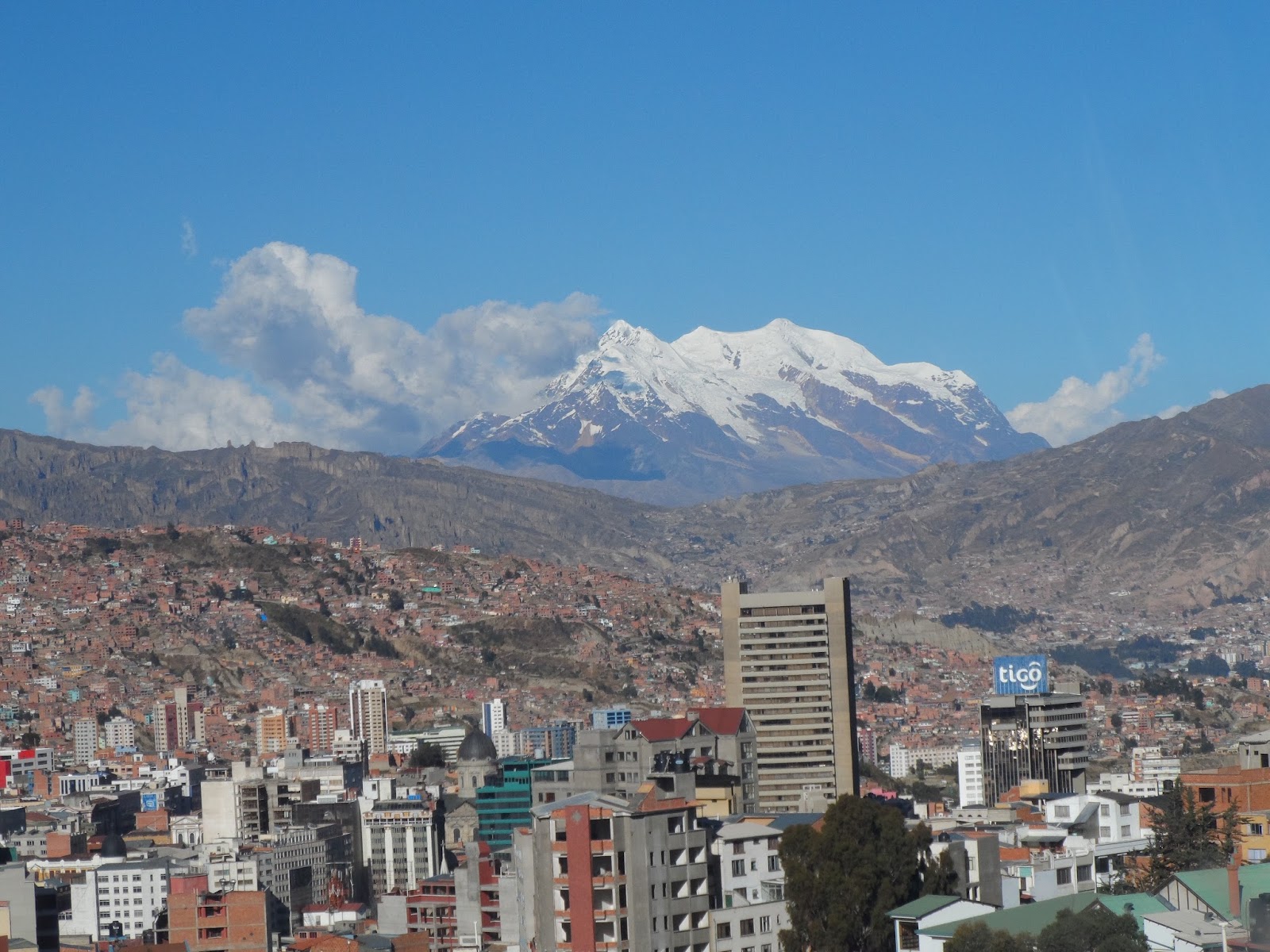
Looking across the city to Illmani  
The red line heading up over the city 
The view down from El Alto 
Looking across the altiplano


4 June 2015

La Paz Day 258 03/06/2015

We had planned to go on a 'tips for tour' walking tour today and as it didn't start until 1100 we took advantage of a leisurely start to the day. We had breakfast in the 3rd floor restaurant of the hotel which, with it's large glass windows, has great views of La Paz's iconic mountain, Illimani, which is Bolivia's second highest mountain at 6438m. The breakfast was sumptuous and delicious and we took our time enjoying the food and views. The tour, run by Red Cap, started at the Plaza San Pedro, which we had visited briefly yesterday, and there we met our 2 hosts and 8 other people. The guys explained that the square was actually named after the church on the corner, not General Sucre, the founder of La Paz in 1548, who has his statue in the middle. Alongside the plaza is the notorious San Pedro prison. It has a capacity of 400, but at the moment there are over 2400 people in there. The main reason for them being incarcerated is for drug offences, with a average sentence of 8 years. However as Bolivian justice works on the principle of 'guilty until proven innocent' many are in there awaiting trial which can take between 3 to 5 years; some have died in there before ever getting to court. Inmates have to pay for being in prison and as most can't afford to pay this and for their family to live outside, they are joined by their loved ones inside. The costs range from B$50 (£5) per month for a space in a room with 12 other people to B$5000 (£500) for a whole wing, known as penthouses! In order to fund their stay prisoners work in the coffee, carpenters, textile, artisan shops all in the prison and it is apparently like a village in there. Until a few years ago tourists could pay to spend a day or even a couple of nights inside, interacting with prisoners and buying their goods. However after a few rapes and murders of tourists by the felons, the prison authorities understandably put a stop to it. There are also bad ways to fund your stay in there, which usually means buying and selling 'sugar', the local slang for cocaine. Apparently some of this produce is thrown over the prison walls by the convicts, where drug dealers quickly collect it before being nabbed by the police. We were advised that if we were walking near the prison walls not to pick up any strange looking bags or else we would become the 2401 inmate! For more information please read the following link  www.independent.co.uk/news/world/americas/san-pedro-prison-a-very-strange-tourist-attraction-2345166.html. With that said we walked out of the plaza and up a block to Calle Zollo Flores. This actually runs parallel to the street our hotel is on and has a huge market. We were pleased we skipped the meat section (which includes bull's penises) and spent our time in the colours and fragrance of the fruit and vegetable stalls. These are usually brought in each day and the ladies on the stalls spend all the daylight hours selling the goods, gossipping and also acting like local 'agony aunts'. From there we walked a couple more blocks to the famous Witches Market (Mercado de Hechiceria). We were told that the local people believed in a mixture of catholicism and indigenous deities and had strange potions to sell to improve your love life, keeping your man subservient (Di wasn't allowed to buy this) and a local type of viagra (although the doses are meant for horses so it has caused many a heart attack while they are 'on the job' which has meant the local prostitutes aren't happy!). Also for sale are llama foetuses which are meant to be good for mother earth (Pachamama) if buried and we remembered how we had seen a couple of them strung up yesterday when we were here (Simon had tried to convince Di they were toys!). We then strolled to the nearby San Francisco church which was built in 17th century. It was very impressive and alongside was it's museum which we thought we would go along to tomorrow. Across the plaza in front of the cathedral was the food market with hundreds of stalls. We tried the local Ilauchas (which is fried mashed potato with meat and cheese in the centre), a banana and peach smoothie and rounded of with an Api (which was fried batter with cheese inside coated in sugar); all were very fresh and tasty and cost a grand total of B$17 (c£1.50). From there we crossed the main El Prado highway moving from the indigenous area to the old Spanish area, arriving at the Plaza Pedro Murillo. Surrounding this were impressive buildings, including the Presidential Palace, the Justice house and the main city cathedral that took 200 years to build and was only just finished for the 1988 visit of Pope John Paul II. The square has witnessed a lot of the political turbulence that has marked Bolivia's 289 year history including the hanging of President Villarroel in 1946 when the rich people weren't happy with his policy of ending the slave trade here (the spot where the gallows were now has his bust on a plinth) right up to recently in 2003. This was when the locals rose up against the president at the time who had already sold most of the gas rights of the country to Petrogas, a Brazilian company. He pocketed half the proceeds, managed to dodge the riots and bullets when escaping his place in the plaza (all the buildings still have bullet holes) and fled to the USA. His nickname is Goni and as he has dual US and Bolivian nationality they have been unable to extradite him, which means their relationship with the States is sour to say the least. Goni is apparently alive and well living in luxury in Maryland! Not surprisingly the current president, Morales, does not live in the palace on the square living instead in a large house 'somewhere in the south of the city'. He is also a colourful character and speaks before he thinks and has many non PC George W Bush type comments in his speeches including "if  you drink coca cola it can make you gay" (later thankfully retracting it!). However he is loved by the local people as he is the first indigenous president and when the constitution of the Republic of Bolivia stated you can only serve 2 terms, he changed the name of the country to the Plurinational State of Bolivia, meaning he can serve another 2 terms if elected, which he was to his third term last November. We left the plaza, crossing the El Prado back to the old city and finished our tour at Oliver's an English style pub. We were treated to a local Bolivian type drink, which was part orange cordial and part alcohol (bit like tequila), which you had to down in one. We said goodbye to our hosts, paid a tip and went next door to the Sol y Luna cafe, recommended by our friends Dan and Dawn for a drink, sussed out the Star of India curry house next door, with plans to go tonight and then walked back to the hotel. After checking out the hotel would charge us B$84 each for the 4 hour bus journey to our next destination Copacabana, we decided to use the local tour operator over the road, who ran their own modern buses but only charged B$30 each. We spent the rest of the afternoon reading and chilling (we also booked to go on Red Caps extended tour of the city tomorrow) before heading out to the curry house for our evening meal. There we enjoyed an excellent couple of curry chicken dishes (Jalfezi amd Tikka Massala) and feeling full and content we strolled back the 10 minutes to our hotel.
The view of Illimani from our hotel 
Plaza San Pedro 
Local handicrafts for sale 
The Witchers Market  
Iglesia San Francisco   
Plaza San Francisco 
Waiting for our milkshake...  
and Api 
The city's cathedral 
The justice building (note the clock goes anti clockwise!)  
Ladies in traditional dress 
Murillo 
Presidential Palace 
Bullet scared buildings around Plaza Murillo 

La Paz Day 257 02/06/2015

A few days ago when we arrived in Sucre we looked into how we would get to our next stop in Oruro. When we found out the bus would retrace our steps to Potosi and then take 10 hours to get there, before having an early start the next day to La Paz we decided to give it a miss and head to La Paz direct. We then discovered that all the buses took between 12 and 14 hours and went overnight. Therefore our desire to witness the stunning countryside as we weaved up and down the Andes was not possible. We had a quick look into how much it would cost to fly thinking it would be cost prohibitive. To our amazement and delight it was very cheap at only £50 each so it was a 'no brainer' and we booked the flight. We had an early breakfast at Casa Verde, said our goodbyes to Rene and took the 20 minute taxi ride to the airport. The check in, security and boarding were all hassle free and we were up in the air bang on time at 0940. We crossed the Andean mountains and foothills below us, for the short 40 minute flight to La Paz airport, located above the city on the Altiplano. Despite the altitude (the airport is at 4060m) the landing was very smooth although it did take an inordinate amount of time to come to a stop. We certainly wouldn't be keen to fly here direct from the UK (or anywhere at sea level). The runway is apparently 5km to allow for the time required to take off and land plus the planes have to have specially reinforced tyres to withstand the reduced pressure. The city itself is one of the most cosmopolitan in South America but it is also one of the most dangerous too (if you read Lonely Planet or a host of other similar sights you would give it a wide berth). However it is meant to be very beautiful and one we wanted to experience plus it was on the way to Lake Titicaca. We had booked the Hotel Rosario, which was just over our budget but it looked a nice hotel and is located in the more touristy part of the city. We had pre booked a taxi with the hotel and found our driver waiting for us as we left the arrivals hall. We drove down into the large valley where the city nestles along the 3750m floor. The surrounding sides of the valley are covered in red brick properties and the backdrop are some fantastic snow clad peaks of the nearby Corderilla Real. The traffic and noise as we neared the centre was the usual chaos and volume for this part of the world and we arrived just after 11am at our hotel. As our room was available we were able to check in and spent a couple of hours reading into what we fancied doing here for the next couple of days. We then walked a couple of blocks further down into the narrow alleyways where many local artisan shops are and found a cafe with a balcony overlooking one of the streets. After nachos and lemonade we headed to the Plaza to check out where Red Tours start their city tour which we we planning to do tomorrow morning. After confirming it started at 1100 we walked back up the road on which our hotel was feeling the heat of the sun and the effects of the altitude. So much so we thought we deserved a cake. We came across El Cafe de Mundo and had a chocolate overdose, with Diane having hot chocolate to drink and chocolate banana crepe to eat, whilst Simon went for a chocolate milkshake plus a large dish of crushed Oreos with lashings of cream. We almost raced back to our hotel with our sugar rush, although Diane immediately crashed and had an afternoon's nap. In the evening we went to a local Cuban restaurant and had a tasty meal before heading back to the hotel.
Enjoying our last breakfast at Casa Verde 
Our plane to La Paz 
A rather large chocolate overdose 

3 June 2015

Cordillera de los Frailes Day 256 01/06/2015

A new day and a new month started with us having breakfast at 0730 before walking through the Plaza to Jaku Tours, the company we had booked to go on a day trip with. Arriving bang on time we found the offices shut and no answer to the bell. However 5 minutes later our guide, Angelica arrived, followed 10 minutes after that by a young Canadian couple, Matt and Kirsty, who were also on the tour. Our driver, Irwin, soon appeared and we drove out against the busy Monday morning rush hour traffic, heading north west passing the airport and into the hills. We had to go through 2 police checkpoints (Angelica explained that as Bolivia was the second highest producer of cocaine and we were near the main production the checks were necessary to try and limit the drug trafficking). After about 90 minutes we arrived at the top of a very beautiful pass at Chataquila, with stunning ridges either side of us. This was to be the start of the couple of hours trekking, along an Inca trail that was part of the Potosi to Cusco highway in the 14th and 15th century. This section of the trail covers 6km and 700m, luckily all down hill as we were starting to feel the effects of the altitude again at 3850m. Before setting off, we went to a local chapel and also visited the statue of a local, famous 19th century independence fighter, who was killed by the Spanish at this spot. We then commenced our hike, with fantastic views down and across the Cordillera de los Frailes and with the impressive Maragua Crater coming more into view. We stopped quite often for photos and also for Angelica to tell us about the many different herbs and plants along the route. She also explained that this route was used by Inca messengers, who often walked 12 hours a day with their messages, which the Inca's used an elaborate number of strings with beads on as writing. At the bottom of the path, we crossed one of the many aqueducts (again from the Inca times) and came across the road, where we paid a lady the fee for using the path which was B$20 each (£2). The water from this valley feeds into Sucre and we were told that due a landslide the water was cut off in the city for 7 days, causing mayhem; glad it didn't happen when we were there. After a 10 minute wait, Irwin arrived in his Mitsubishi jeep and we headed along the dirt track for another 45 minutes arriving at the village of Maragua. About 10 minutes before we got there we stopped to take pictures of the stunning red and violet crater, which swept around us in a 270 degree arc. It was huge (over 8km wide) and had amazing rock lines and markings almost scallop shaped all across it. Lonely Planet describes it as 'one of the most visually striking places in Bolivia'. There are many theories as to how this was created with the local people but the common scientific one is that all this was under the sea and the underwater volcanic eruptions and the water movement created this fairly unique lines. On arrival at the village, we saw many children out playing as this is the location of the main school for the whole area. Angelica and Irwin had brought lunch and we tucked into a very tasty spread of  bread, avocado, two different types of local cheese, boiled eggs, tomatoes and cucumber. After lunch we travelled further into the valley before alighting in order to walk into the countryside, criss crossing over old lava and moraine fields, passing shepherdesses and local villagers in the fields. Our destination was to visit a side of a hill that had dinosaur footprints preserved in the hardened mud. We had been told before had we would need to pay the local village B$20 each. Just before we arrived a couple of villagers greeted us; we thought them to be mother and son. However as they engaged with Angelica it became clear that the man was acting on behalf of the local community and was the one to pay, not the older woman who we initially thought was loco but found out she was drunk. Another party of 6 'gringos', as the man kept saying, had paid her the fee incorrectly and she had used it to get plastered! After paying the guy our money we walked around the corner to view the footprints. Archaeologists have excavated the ground on the slope and there were over 150 footprints, from what they believe to be over 8 different species. They could only identify 2 of the species, being the T Rex and Brontosaurus. We wandered around the site looking at some of the impressive footprints created by creatures over 65million years ago, trying to imagine the scene of the climbing the slope out from what was believed to be a watering hole. They have been preserved by the lava flowing from what was a nearby volcano and then buried until 1999 when one of them was discovered by a local farmer. We then retraced our steps to the jeep, and then returned to Sucre over the spine jangling roads, to arrive back at the tour offices at 6pm. We headed back for to the b&b for a quick shower and then went for dinner at La Florin, where we had gone the first night. We enjoyed a fine last meal in Sucre, washed down with a pint of local beer, reflecting on how enjoyable our stay has been here in this very beautiful city. It is definitely a place people should come to if they visit Bolivia.
The chapel at Chataquila 
The start of the Inca trail 

The trail winding it's way down the hillside 
Looking across towards Maragua 
The road back to Sucre 

The local transport 
Maragua crater 
The school classroom 
Walking like T-Rex 
Brontosaurus footprint 
T-Rex footprint 
The local village with communal oven in the centre 
A shepherdess with her flock of goats and donkeys 

2 June 2015

Tarabuco market Day 255 31/05/2015

After another excellent breakfast at our lodgings we headed into the centre of Sucre to wait for our tour bus to take us to Tarabuco. The indigenous village, 65km southeast of Sucre, has a Sunday market and is apparently the most renowned place for textiles in Bolivia. There were quite a lot of people waiting to go on the tour so we were split into 2 parties to take a micro bus each. We were immediately told that we would be returning at 1300 instead of 1500 but we weren't told why (could be due to the ongoing strike or maybe the drivers had a "hot date" that afternoon!). The two hour journey to Tarabuco involved us climbing up 3 ridges and down 2 valleys to arrive there at 1000 at a height of 3200m. On arrival we were ushered into a patio area which served as both a restaurant and stage for local shows. The lady who greeted us provided us some good information on how to walk to the market (which was only a few blocks away), gave us a few phrases we could use in Quecha, the local language, and what to look for to determine if the textiles on sale were either original or fake (it's all down to the feel - the rougher it feels the more assured we can be it is genuine). After this we had a bit of a sales pitch about coming back to their restaurant to eat and watch a local dancing show at 1230, but we declined the offer to reserve a table in advance and walked into the main plaza. This was a typical Spanish style square but the 4 statues were all of local people slaying the Spanish in the war of independence in the 1810's. One was rather gruesome as you will see from the photo below. We walked around the square, went to the local tourist information centre (which as usual for Bolivia was closed) and wandered around a few of the narrow streets where market stalls were in abundance. Everything was for sale there from toiletries, domestic cleaning goods, crappy sports clothes (not out of place in Sports Direct!), TV and audio goods (last seen in the 90's!), footwear as well as lots of stalls selling the locally woven products. The cloths were of good quality and Diane remarked that she would have bought one if we were here on holiday but not now as we would have to carry it around for the next 4 months. We headed back to the square and stopped at a cafe and enjoyed a bottle of coke each. The 'waiter' was the son of the owners who Simon got chatting too and in his best Spanish found out his name was Martin, 9 years old, had three siblings, didn't like football but liked baseball, his school was 2 blocks away and he was tall for his age and his whole family were one of the tallest in the village. Martin also said a lot more but that was the extent of Simon's Spanish. Martin was intrigued with Simon's baseball cap, didn't know what cricket was (a type of baseball was the best we could explain) and when we went through the country's badges on the cap, he knew a few of them but not all (impressive geography knowledge). After a quick photo of him, he advised the bill for the drinks was B$14. Simon gave him a B$50 note and he went into the cafe for what we thought was get us change. We waited for 10 minutes and after still no sign of Martin, Simon went inside and asked his sister to find Martin and our change. He came back a couple of minutes later and gave us B$6, stating we only gave him a B$20 note. Simon's Spanish is good enough to tell him 'no, it was a B$50 note' and with a shrug Martin produced the other B$30 from his pocket. Cheeky little sod and we thought we were friends! However he had a cute smile and he did help with Simon's Spanish so we gave him a B$2 propina (tip) and told him to be more honest with us gringos in future. With a shrug and a wave he was off. By now it was 1200 so we had another stroll around, ate our biscuits and tangerines we had brought with us (we are still not brave enough to eat the street food) and then headed back to our meeting point. The restaurant was full, thankfully the show was over so we  hopped on the bus and headed back to town. Diane's eyes were smarting from what she thinks is due to the strong sunlight (she had to wear Simon's hat for most of the day) and she slept/kept her eyes closed on the return journey. We arrived back in Sucre at 1430, took out some more money from the National Bank of Bolivia's ATM (we can take out the full amount of £300 unlike Chile and Argentina where it's less than half that, doubling the bank fees when we were there) as most places including the b&b want cash, enjoyed a crepe chocolate (Di) and apple crumble with ice cream (Simon) at a local French Patisserie, then headed back to Casa Verde to read and plan in the late afternoon sunshine.  
The main square in Tarabuco 
Villages bringing goods to sell 
A gory take on the independence 
Martin aka little sod!  
The village church 
A lovely array of colours 
Looks like dynamite but it's actually cigarettes 
All modes of transport used to get to the market